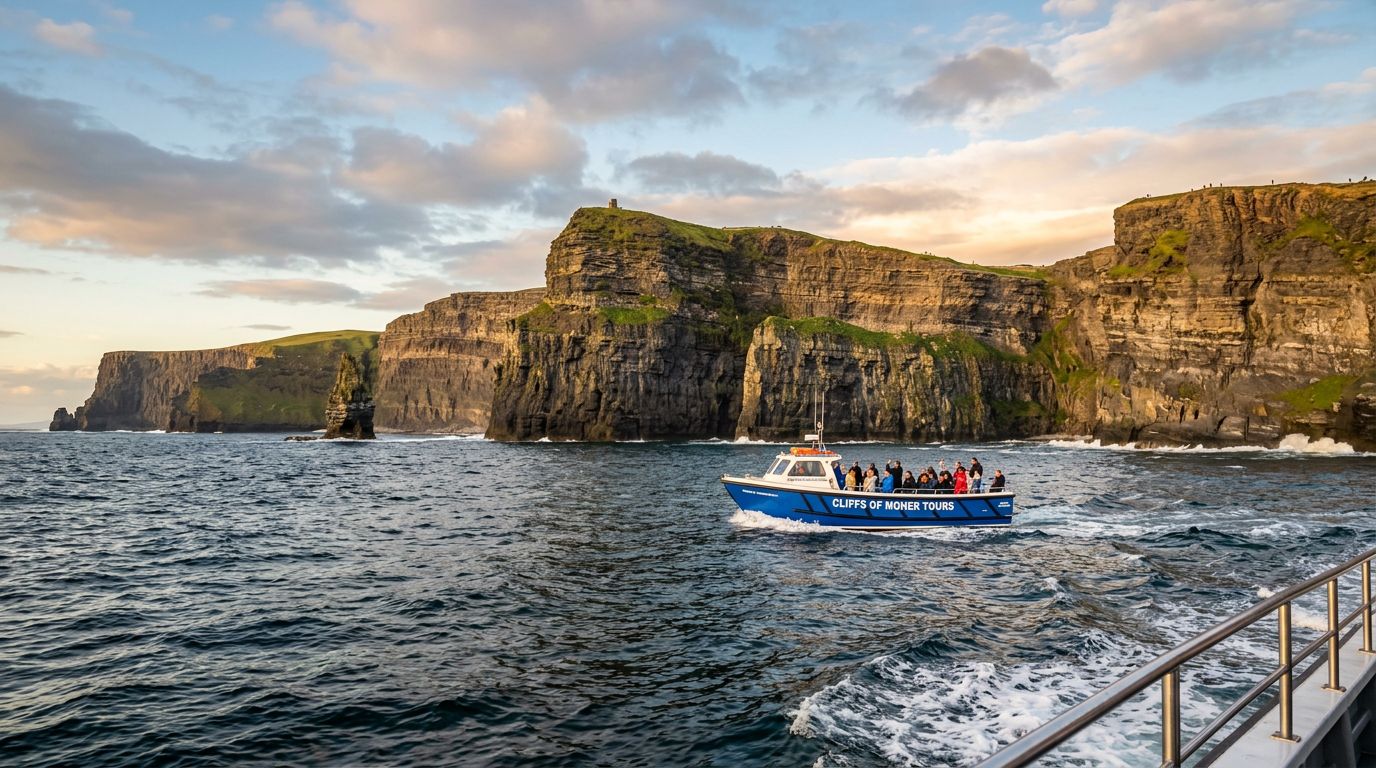
50 min
Cliffs of Moher Boat Tour from Doolin Pier
- Entry ticket
- Mobile voucher
- Valid same day
- Free cancellation
Cliffs of Moher Boat Tour — Atlantic Cruises & Sea-Level Access
214-metre vertical cliffsides from the waterline, puffin colonies in season.
Compare fares, pick the fit — all bookings are mobile-voucher and eligible for free cancellation where shown.
50 min
13 hr
10 hr 30 min
They complement each other; visitors who prioritize scale and vertical perspective choose the sea-level cliffs of moher boat tour, while those preferring panoramic coastal vistas favor the official land-based trails. Both provide distinct ways to appreciate these Atlantic landmarks.
|
Top pick Boat Tour |
Land Access | |
|---|---|---|
| Perspective | Vertical sea-level view | |
| Physical Effort | Low (seated) | |
| Crowd Exposure | Moderate (vessel capacity) | |
| Access to Facilities | Limited (on-board only) | |
| Operational Seasonality | April to October | |
| Views | Marine wildlife and caves | |
| See tickets & prices |
Verdict: The sea-level cliffs of moher boat tour tours offer a raw look at the rock strata, whereas land trails provide extensive cliff-top hiking opportunities with flexible cliffs of moher boat tour tickets options for all-day exploration.
Hand-picked experiences loved by thousands of travelers
8 hours
Free Cancellation
Eight unforgettable hours exploring Ireland's wild west coast, from medieval castles to 214-metre sea cliffs.
13 hours
Free Cancellation
13-hour scenic escape from Dublin to Ireland's iconic cliffs, wild Burren landscape & medieval Galway.
6 hours
Free Cancellation
A 6-hour private escape through County Clare's most iconic landscapes, from cliffs to coastline.
Check in at Visitor Centre and use facilities
Built in 1835, this stone landmark offers elevated views of the coastline and five counties on clear days.
A cave-like structure containing exhibits on the 320-million-year geological history of the cliffs.
Interactive displays explain the local folklore, mythology, and natural bird life of the region.
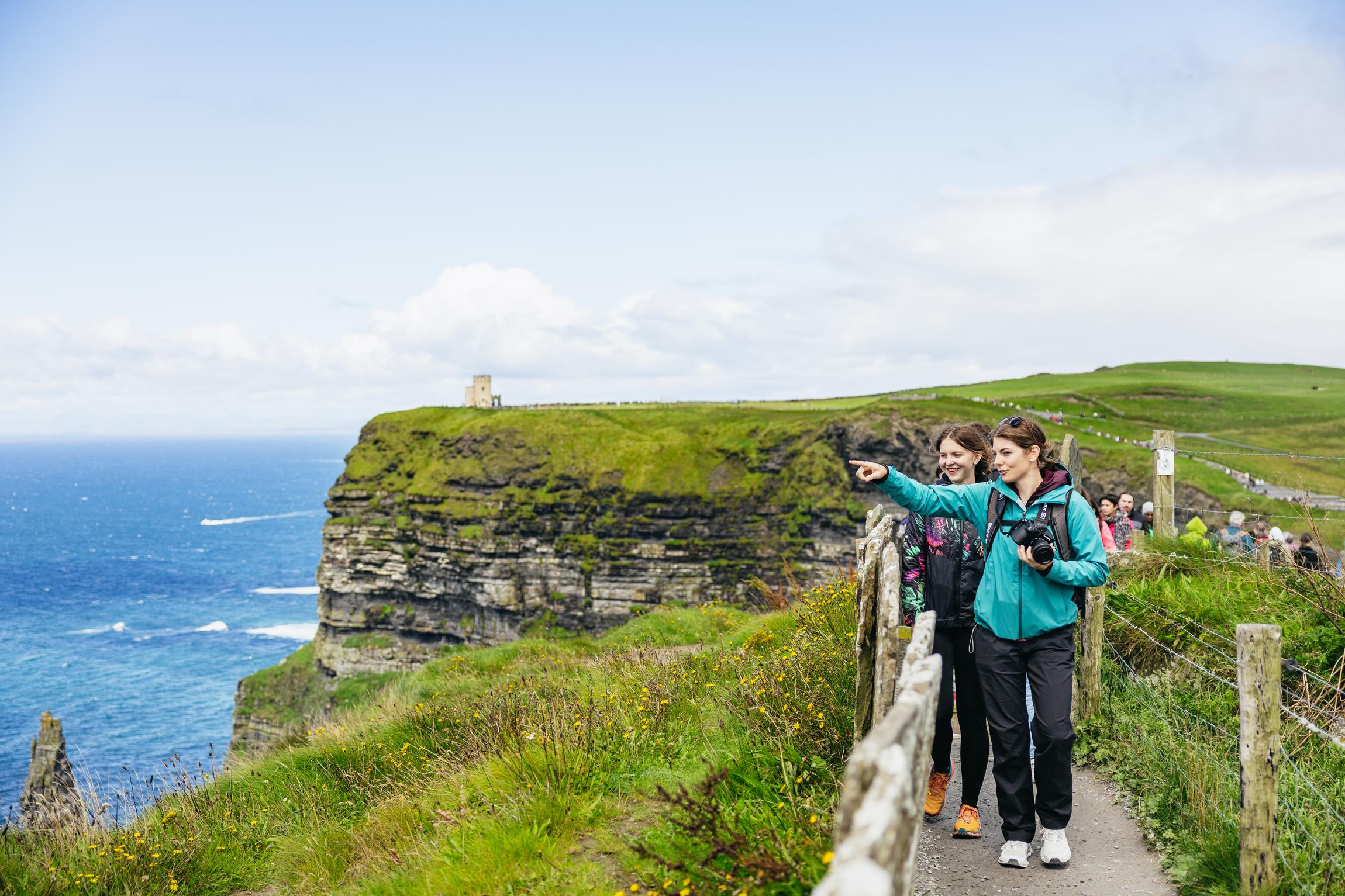
Eight hundred metres of paved trails offer safe walking and dramatic vistas along the cliff edge.
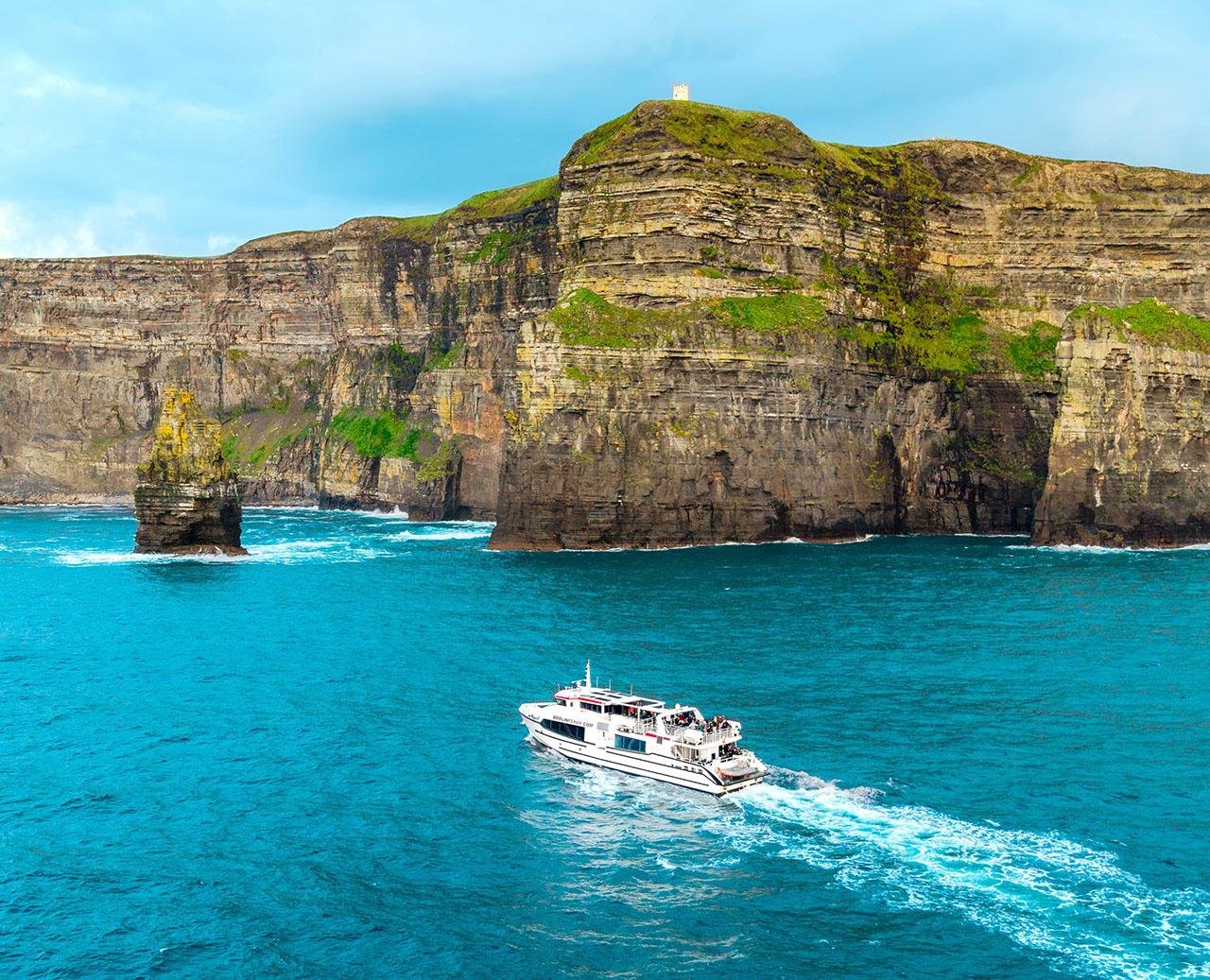
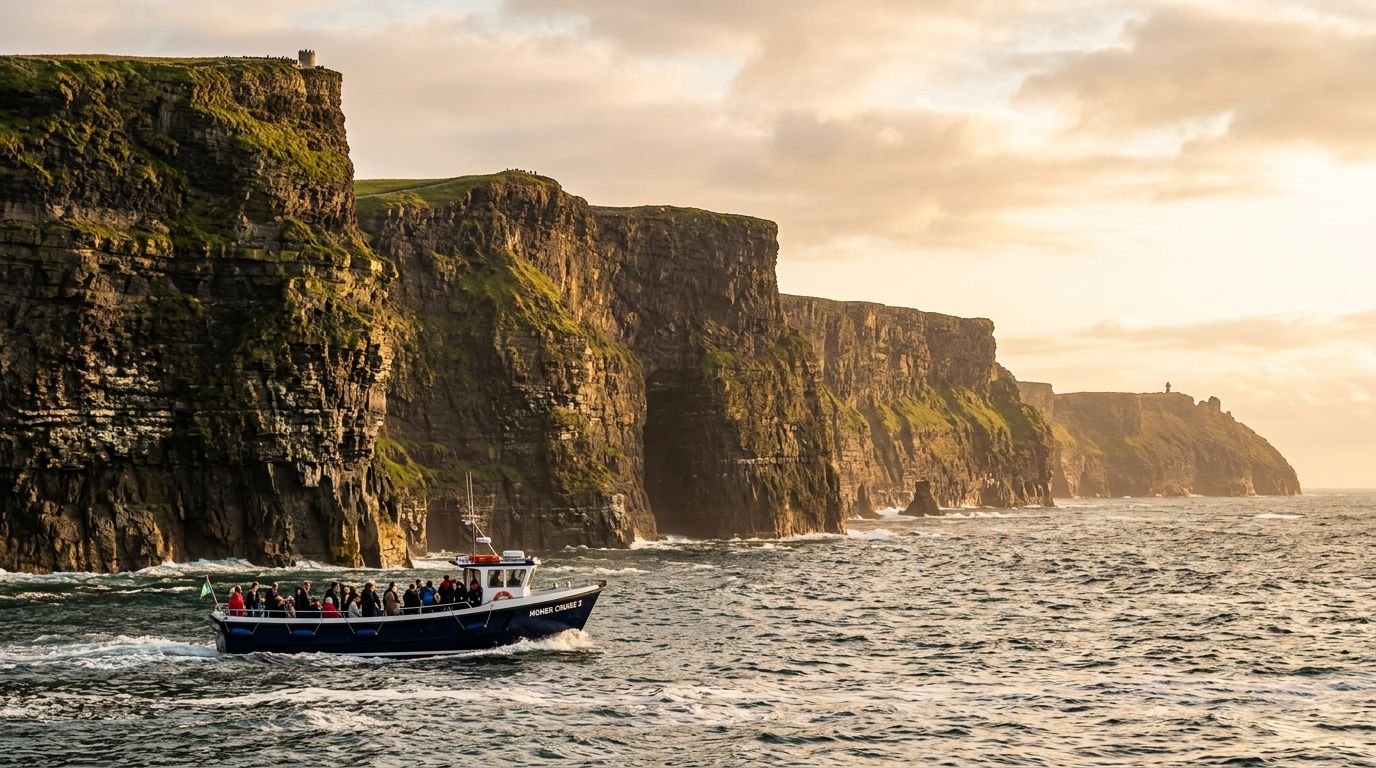
You board at Doolin Pier, stepping from stone quay to rubber gunwale as the skipper steadies the rigid-hull inflatable. The harbour empties into open water within two minutes. Hag's Head appears first, a grassy promontory marking the southern terminus of the cliff chain. The vessel turns north, throttle opening, and the rock face begins to climb. You pass the first sea stack, a detached pillar standing 30 metres offshore, its summit crowned with thrift and sea campion. Guillemots cluster on narrow ledges, wings folded, beaks angled upward. The engine cuts to idle as you drift beneath the main cliff section. Water slaps the hull. Above, the strata tilt in parallel bands — dark shale, pale sandstone, dark again — each layer a compressed delta from the Carboniferous. The boat noses into a shallow cave, its entrance framed by dripping overhangs. Inside, the air smells of salt and bird lime. You emerge and continue north toward the tower platform, visible as a grey cylinder on the skyline. Puffins skim past in pairs, wings beating fast, orange feet trailing. The skipper gestures toward a slot in the cliff where kittiwakes nest in vertical tiers, each bird occupying a chalk-white ledge barely wider than its body. The return leg runs parallel to the outbound route, but the light has shifted, casting shadows into crevices and accentuating the horizontal bedding planes. You dock 90 minutes after departure, legs stiff from standing, jacket damp with spray.
All the details about your upcoming adventure in one place
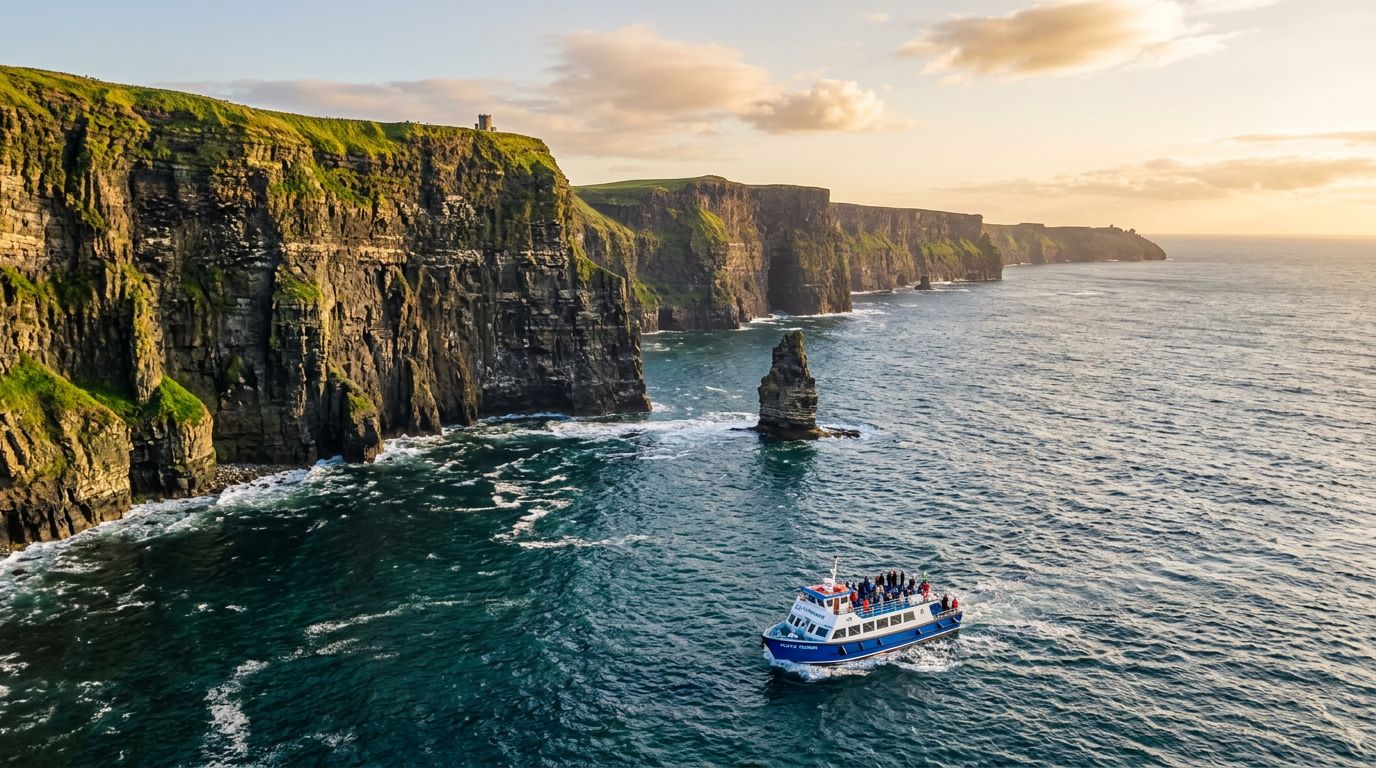
A cliffs of moher boat tour departs from Doolin Pier and navigels beneath the 214-metre sea cliffs, offering perspectives of rock formations, seabird colonies, and cave systems invisible from the clifftop visitor centre. These Atlantic cruises operate from March through October, weather permitting, with guides identifying geological features like the Branaunmore sea stack and O'Brien's Tower perched 120 metres above. Cliffs of moher boat tour tickets include life jackets and waterproof gear for the coastal approach.
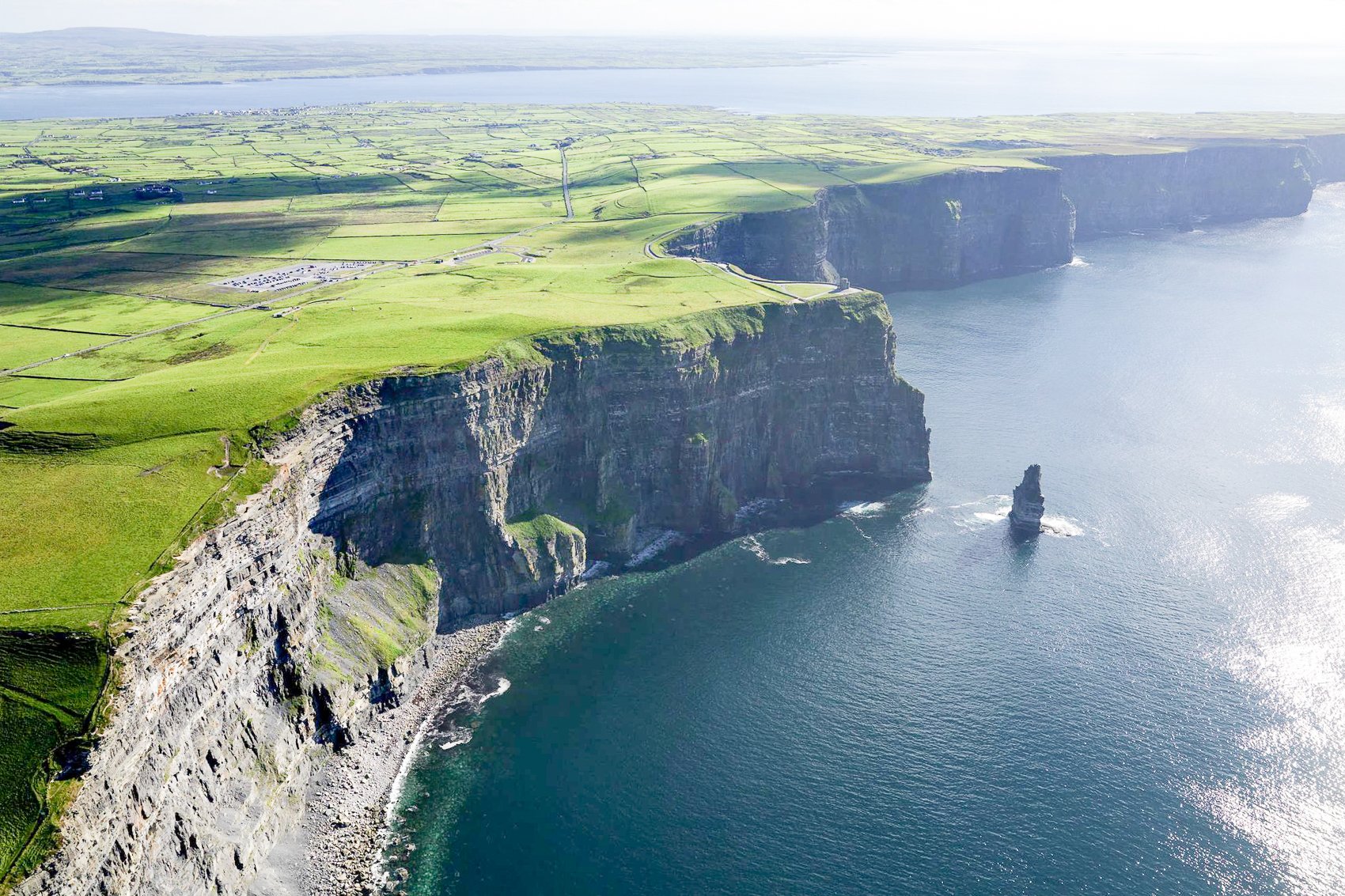
The Cliffs of Moher rise 214 metres from the Atlantic at their highest point, a sedimentary wall of shale and sandstone deposited 320 million years ago during the Carboniferous period. From sea level, the scale shifts. What appears as a distant ridgeline from O'Brien's Tower transforms into a vertical face of stratified rock, each layer recording an epoch of ancient river deltas. The cliffs stretch eight kilometres along the Clare coast, from Hag's Head in the south to the tower platform above Doolin in the north. Erosion proceeds at roughly one centimetre per year, driven by Atlantic swells and freeze-thaw cycles. The rock face itself hosts 20,000 breeding seabirds between April and July, primarily razorbills, guillemots, and Atlantic puffins. Marine tours departing from Doolin harbour pass beneath nesting ledges inaccessible from the clifftop pathways, revealing caverns, sea stacks, and the horizontal bedding planes geologists use to trace Clare's subsidence history. The cliffsides were declared a UNESCO Global Geopark site in 2011, part of the Burren and Cliffs of Moher Geopark spanning 530 square kilometres. Cliffs of Moher boat tour operators run zodiac and rigid-hull vessels between March and October, weather permitting. Departures concentrate in the midday window, though morning sailings offer calmer conditions and softer light for photography. The boat route covers roughly twelve kilometres, threading between offshore pinnacles and the main cliff face. Viewing angles change continuously. At Aill na Searrach, the cliff recedes to form a shallow amphitheatre where kittiwakes nest in tiered colonies. Near Brandy Hole, a sea cave penetrates 30 metres into the base of the formation, its ceiling black with guano and dripping condensation. The water itself is a cold 11–14°C year-round, fed by the North Atlantic Current. On calm days, jellyfish drift past the hull in translucent clouds. Dolphins and minke whales appear sporadically, more common in late summer when mackerel shoals move inshore. The geological strata visible from the sea tell a specific story. Dark shale bands represent deeper-water deposits; pale sandstone layers mark periods when deltas prograded westward, building new land into the shallow basin. The cliffs tilt slightly southward, dipping at one to two degrees, a remnant of tectonic compression during the Variscan orogeny. This slight angle makes the northern cliffs appear taller from sea level. The €15 conservation fee collected at the visitor centre funds erosion monitoring and clifftop pathway maintenance, but does not apply to marine departures booked independently through Doolin or Liscannor harbours. Those departures operate under separate harbour authority permits, with safety protocols enforced by the Irish Coast Guard.
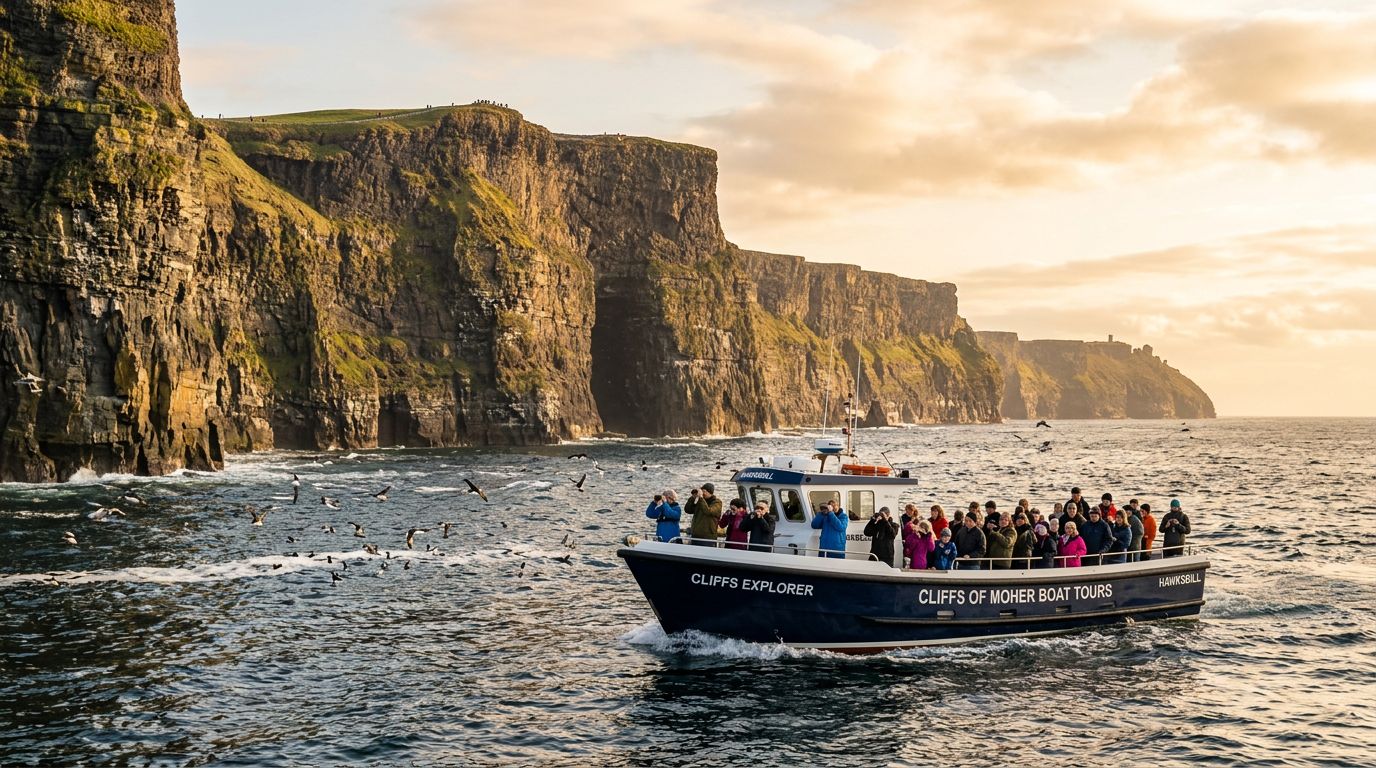
From sea level, each stratified layer records an epoch of ancient river deltas, 320 million years in vertical section.
Sturdy footwear and weather-appropriate layers are essential for a cliffs of moher boat tour and coastal trail visit. Expect rapidly changing conditions, as four seasons can occur in one day.
Free baggage storage is located in the gift shop on the ground floor of the Visitor Centre. Security staff monitor site safety to ensure all visitors enjoy a safe cliffs of moher boat tour experience.
Photography is permitted, but drones are strictly prohibited at the cliffs of moher boat tour site to protect local bird populations and ensure visitor safety. Use compact cameras or mobile devices for the best results.
The site is well-suited for families, with interactive exhibits and virtual reality cliff-face adventures. A cliffs of moher boat tour is a memorable way for children to see marine wildlife like puffins.
The Visitor Centre is fully accessible with lifts and designated parking. An electric mobility vehicle, the Lifts of Moher, is available to transport visitors to viewing areas for a seamless cliffs of moher boat tour connection.
On-site cafes and picnic areas are available for visitors. A cliffs of moher boat tour departure point in Doolin also offers local dining options.
Opening hours
08:00–21:00
Address
Cliffs of Moher Experience, Lislorkan North, Liscannor, County Clare, Ireland
Accessibility
Full visitor centre access, mobility vehicles available
Best arrival window
08:00–10:00
Baggage storage
Free storage available in gift shop
Site access
Paved pathways, 15 EUR conservation fee
Car · Variable · Parking fee included
Follow signs to Liscannor or Doolin, parking is included with site entry.
Public transport · Variable · Check local schedules
Bus services connect local villages to the visitor centre.
Visitors can amend their booking via their email booking confirmation link. Admission includes a 15 EUR conservation fee per person, gate rate.
Recommended time
4-5 hours
To experience the landscape fully, dedicate time for both land-based walking paths and a cliffs of moher boat tour. Arriving during the best arrival window of 08:00–10:00 allows you to secure cliffs of moher boat tour tickets before the coastal trails reach maximum capacity. Visitors who wish to explore the O'Brien's Tower observation deck or linger near the Atlantic edge should allocate extra time, while those relying on a cliffs of moher boat tour tour might need to coordinate their maritime departure with shuttle logistics. Balancing these local landmarks ensures a comprehensive visit without rushing through the limestone geography.
Crowd levels through the day
Weather · crowds · average price — dots go green to amber to red as each metric rises.
Longest daylight hours, perfect for a cliffs of moher boat tour and observing seabirds like puffins.
Fragrant flora blooms along the coastline, offering beautiful photo opportunities.
Fewer crowds and crisp air make this an ideal time for coastal photography.
Atmospheric, misty views, though paths may be limited by weather conditions.
Reserve your cliffs of moher boat tour tickets online to avoid disappointment during peak hours.
Download the official guide for site history and maps before you arrive.
Never cross barriers; cliff-edge terrain is unstable and prone to rockfalls.
Arriving between 08:00–10:00 ensures a quieter, more peaceful experience.
Always verify if your cliffs of moher boat tour is operating, as sea conditions dictate schedules.
The Cliffs of Moher rose from the seafloor over 300 million years ago during the Carboniferous period, when sediment from an ancient river delta compressed into layers of sandstone, siltstone, and shale. Tectonic shifts lifted the seabed, and millennia of Atlantic storms carved the vertical face that now extends eight kilometers along the Clare coast. The cliffs reach 214 meters at their highest point near O'Brien's Tower, exposing strata that record fluctuating sea levels and climatic shifts across geological epochs. Fossil ripple marks and trace fossils embedded in the rock face document life in shallow tropical waters that once covered this region. Maritime communities have navigated these waters since the Bronze Age, when coastal settlers harvested seaweed and fished the offshore banks. By the medieval period, the cliffs served as a navigational landmark for vessels traveling between Galway Bay and the Shannon estuary. Local fishermen avoided the base during westerly gales, when waves could reach heights of twenty meters and fragment the lower ledges. The 1588 wreck of the Spanish Armada ship *San Marcos* near Mutton Island, visible from cliffs of moher boat tour routes, killed hundreds and left debris that washed ashore for decades. Smugglers used sea caves along the base during the eighteenth century, storing French brandy and tobacco beyond the reach of revenue officers. Commercial cliffs of moher boat tour operations began in the 1970s, when Doolin fishermen started offering summer passenger trips to view seabird colonies and geological formations inaccessible from clifftop paths. Early vessels were converted trawlers with minimal safety equipment. A 1986 near-capsize during a sudden squall led to mandatory weather protocols and life jacket requirements. Modern rigid inflatable boats replaced larger craft in the 1990s, allowing closer approaches to sea stacks, blowholes, and the cathedral-like sea arch at the northern end. Today's licensed operators follow Marine Survey Office guidelines, maintaining minimum distances from nesting razorbills and kittiwakes during breeding season while providing access to coastal features that shaped Clare's maritime identity.
Carboniferous river delta sediments compress into sandstone and shale layers that will form the cliff strata.
Retreating Ice Age glaciers expose the cliff face to Atlantic erosion, initiating the modern vertical profile.
Spanish Armada ship San Marcos wrecks near Mutton Island, killing crew and scattering wreckage along the base.
Smugglers use sea caves at the cliff base to store contraband beyond the reach of customs patrols.
Doolin fishermen begin offering passenger trips on converted trawlers to view seabird colonies and rock formations.
Near-capsize incident during sudden squall prompts mandatory weather protocols and safety equipment standards for tour operators.
Rigid inflatable boats replace larger vessels, enabling closer approaches to sea arches and geological features.
Marine Survey Office establishes breeding-season buffer zones to protect nesting seabirds while allowing sustainable tourism access.
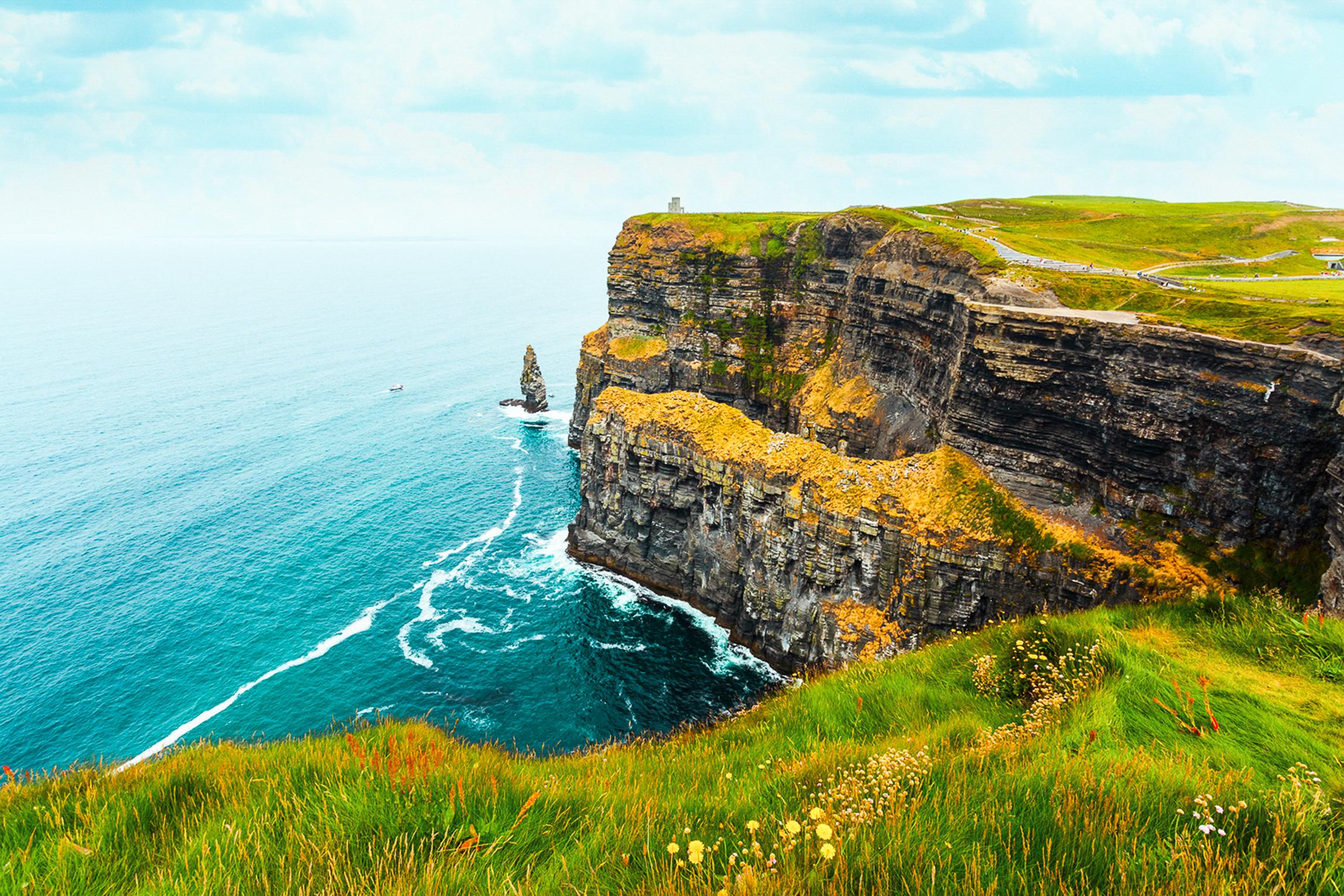
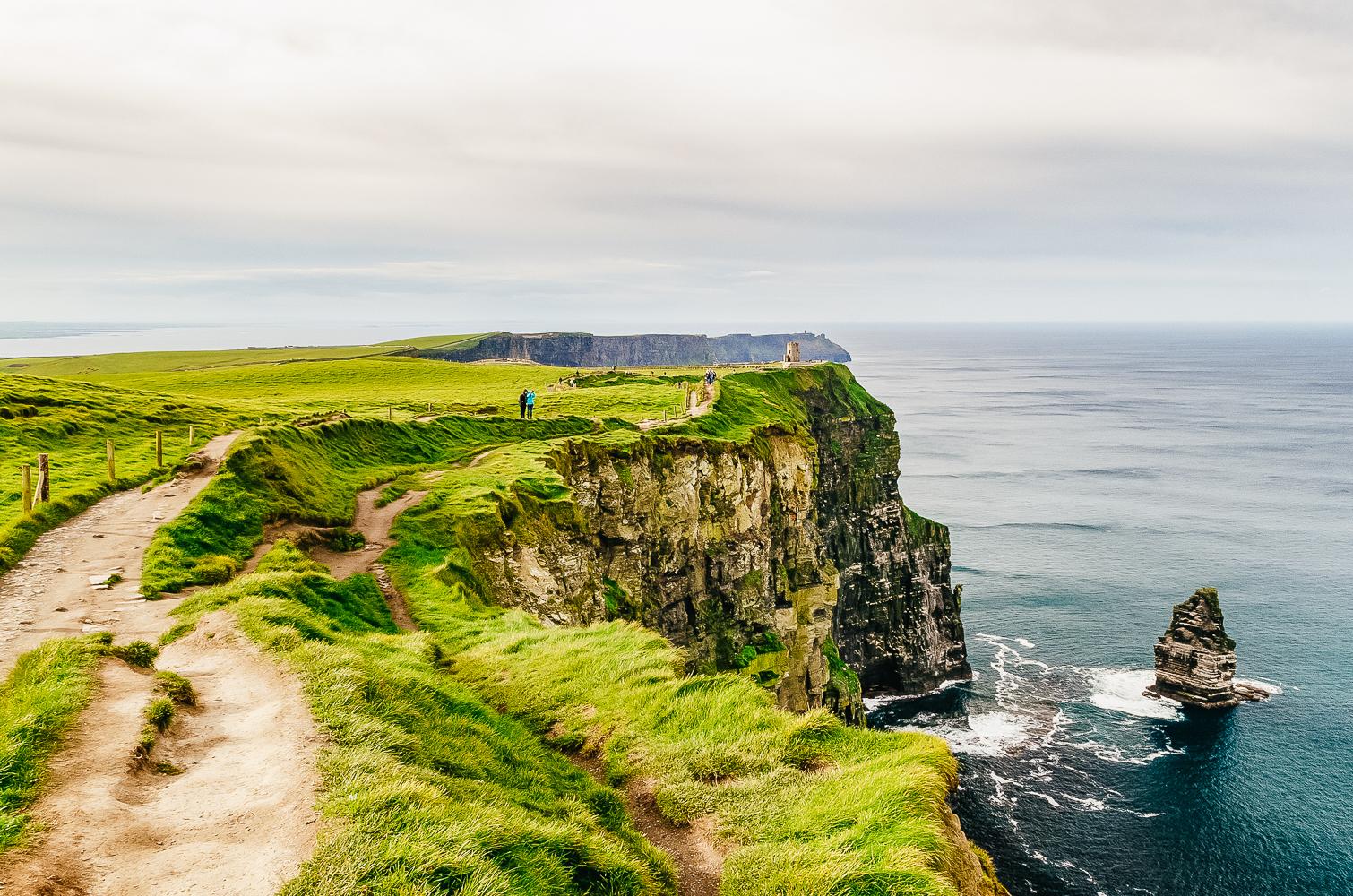
Stand at the edge of the stone wall near the tower for a vertical composition that captures the sheer drop of the limestone layers meeting the Atlantic. This is the most iconic perspective for those using cliffs of moher boat tour tickets to align their sea-level view with the summit elevation.
Position your camera to capture the dramatic jagged rock formation that resembles a profile, providing a stark contrast to the vertical cliff faces. Access this lookout via the coastal path to frame the rugged terrain against the crashing surf.
From this stable viewing area, you can frame the expansive geological strata of the cliffs stretching toward the north. This vantage point allows for wide-angle shots that emphasize the scale of these Irish landmarks during a cliffs of moher boat tour tour.
Captured from the water, this angle looks directly up at the towering sedimentary rock walls and nesting seabirds. Ensure your aperture is set for high shutter speeds to account for the motion of the vessel during cliffs of moher boat tour tours.
Real experiences from real travelers
Viewing the Cliffs of Moher from the water completely changed how I understood their scale. Our guide pointed out nesting razorbills tucked into the rock face. The boat handled the swells well and we stayed dry in the covered section.
We took the 9am cliffs of moher boat tour and had calm seas with perfect light on the cliff faces. Saw several seals near the rocks at Hag's Head. The skipper gave clear commentary about the geological formations without overdoing it.
The sedimentary layers are so much clearer from sea level than from the clifftop path. Our captain navigated close enough to see the sandstone and shale bands. Conditions were choppy but manageable.
The marine tour offers angles impossible from land but we had overcast skies that flattened the colors. Still worth doing for the sea arch at the southern end. Dress warmer than you think you need.
Took the afternoon departure and watched kittiwakes diving near the boat throughout the cliffs of moher boat tour. The guide identified puffins on the ledges using binoculars. Atlantic swell was moderate and added to the experience.
The sheer height becomes real when you're at water level looking up 200 meters. We passed several sea caves and the captain explained how wave action carved them over millennia. Calm conditions made photography easy.
Skeptical about boat tours but this delivered. Saw the cliffs from angles you simply cannot access on foot. Guide timed our approach to catch the light hitting the north face. Wear layers and bring a waterproof bag for your phone.
Three grey seals followed us for ten minutes near the southern cliffs. The boat moved slowly enough for good photos of the nesting colonies. Water was emerald green against the dark rock. Worth booking ahead for summer departures.
The captain explained the 300-million-year-old sediment layers visible in the cliff face during our cliffs of moher boat tour. We could see the distinct bands of siltstone and flagstone. Conditions were perfect with light wind.
Booked this after visiting the clifftop center and glad we did both perspectives. The boat gets you close to formations invisible from above including a natural arch. Seas were moderate and the crew handled everything professionally.
Everything you need to know for your journey
The Cliffs of Moher Experience is open daily from 08:00–21:00.
Admission is 15 EUR per person, which contributes to the conservation of the area.
Yes, you can book your cliffs of moher boat tour and site entry tickets online in advance to save time.
The visitor centre is fully accessible with ramps, lifts, and mobility vehicles available for visitors.
Drones, firearms, and sharp weapons are strictly prohibited on-site.
Visiting during the 08:00–10:00 arrival window helps you avoid peak crowds.
Dogs are permitted in the grounds but not on coastal paths or inside buildings.
Secure parking is included in your entry fee at the Cliffs of Moher Experience.
Plan for at least two hours to enjoy the visitor centre and cliff views.
Historical stone viewing tower built in 1835.
Area known for rich seabird colonies.
Popular eco-conscious stay near boat tour docks.
Convenient coastal location near the entrance.
Join thousands of happy travelers who have discovered this incredible experience
Book Your Experience Now